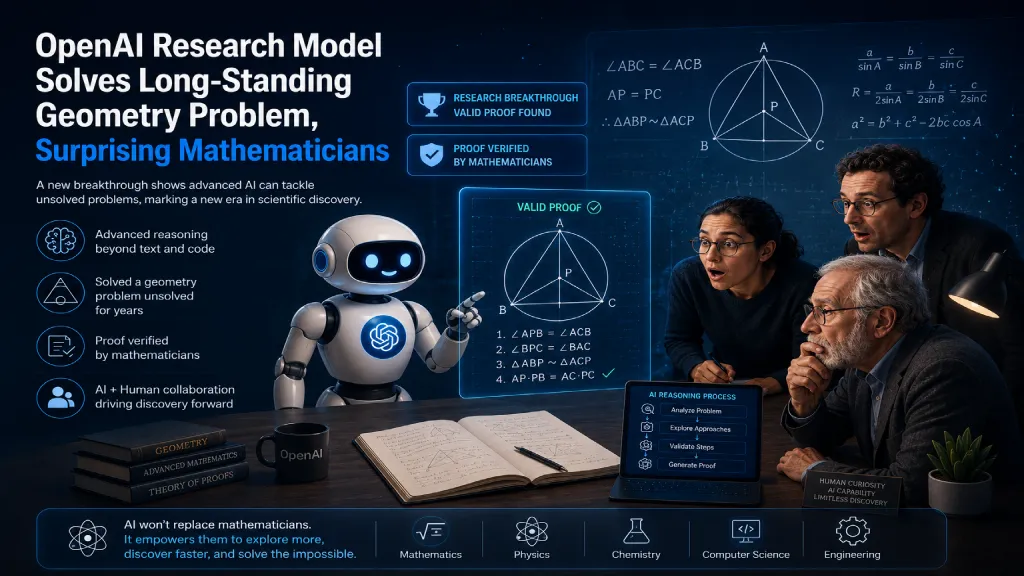
A new artificial intelligence breakthrough from OpenAI is drawing attention from the mathematics community after one of the company’s research models reportedly solved a geometry problem that had remained unsolved for years.
The achievement highlights the growing ability of advanced AI systems to contribute to scientific discovery, moving beyond tasks such as text generation and coding assistance. Researchers say the model was able to analyze complex geometric relationships, identify patterns, and generate a valid proof that satisfied mathematical requirements.
While AI has previously demonstrated strong performance in solving competition-level math problems, tackling open research questions represents a different challenge altogether. Unlike textbook exercises, unsolved problems require original reasoning and exploration of new solution paths.
According to researchers familiar with the work, the AI model evaluated multiple approaches before identifying a promising direction. The resulting proof was later reviewed by mathematicians, who confirmed the validity of the solution.
The development has reignited discussions about the role of AI in scientific research. Some experts view these systems as powerful assistants capable of accelerating discoveries across mathematics, physics, chemistry, and computer science. Others caution that human oversight remains essential, particularly when verifying complex proofs and ensuring correctness.
OpenAI has increasingly focused on improving reasoning capabilities in its latest generation of models. Rather than simply predicting text, newer systems are designed to spend additional computational effort evaluating options, checking assumptions, and refining answers before producing results.
This approach appears particularly effective in mathematics, where logical consistency and step-by-step reasoning are critical. As models continue to improve, researchers believe AI could help uncover new insights in areas that traditionally require years of human investigation.
The implications extend beyond academic mathematics. Better reasoning capabilities can improve software development, engineering design, scientific simulations, and other domains that depend on rigorous problem-solving.
Still, experts stress that AI should not be viewed as a replacement for mathematicians. Instead, many see a future in which researchers collaborate with AI systems, using them to generate ideas, test hypotheses, and explore large problem spaces more efficiently.
If similar breakthroughs continue, AI could become an increasingly valuable tool in advancing human knowledge, marking a new chapter in the relationship between artificial intelligence and scientific discovery.