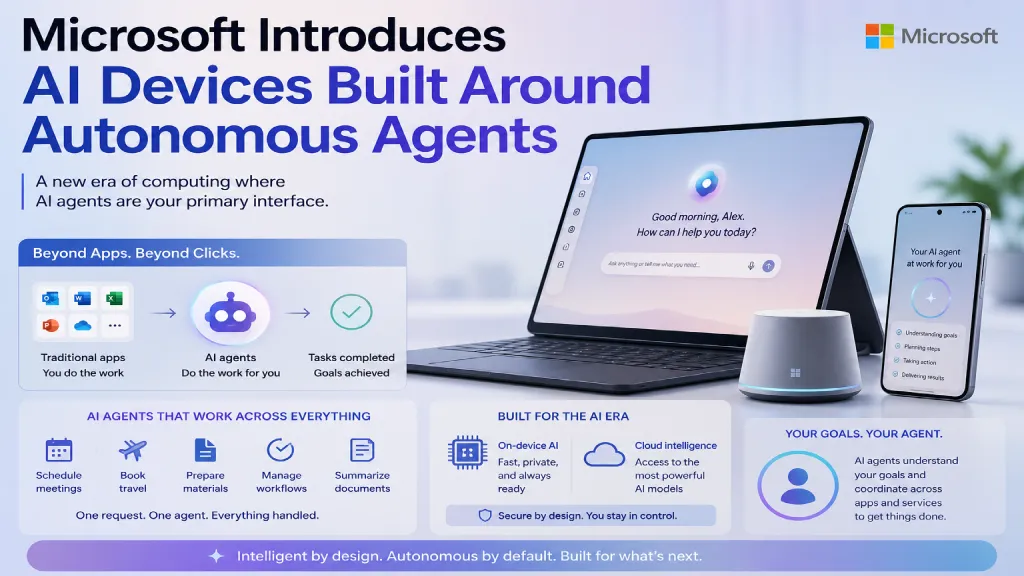
Microsoft has unveiled a new generation of AI-powered devices designed to move beyond traditional applications and place autonomous AI agents at the center of the user experience.
The announcement reflects a broader shift in computing, where AI is increasingly becoming the primary interface through which users interact with technology. Instead of opening separate apps for different tasks, users may soon rely on intelligent agents capable of understanding goals and completing workflows on their behalf.
Microsoft’s vision is based on the idea that AI agents can coordinate activities across multiple services and applications. For example, a user could ask an agent to organize a business trip, prepare meeting materials, schedule appointments, and summarize related documents without manually switching between tools.
The new devices are designed to support these experiences through dedicated AI processing capabilities. By combining on-device computing with cloud-based intelligence, Microsoft aims to deliver faster responses while maintaining access to powerful AI models.
Industry observers see the move as part of a larger trend toward agent-based computing. Technology companies including OpenAI, Google, Anthropic, and Microsoft are investing heavily in AI systems that can perform actions rather than simply generate content.
Traditional software applications are unlikely to disappear entirely, but their role may change. Instead of interacting directly with dozens of separate interfaces, users could increasingly communicate with a single AI assistant that coordinates underlying services.
The concept has significant implications for productivity. Businesses are exploring how AI agents can automate administrative work, manage information, and support decision-making processes. If successful, these systems could reduce the time spent on repetitive digital tasks.
However, challenges remain. AI agents must operate reliably, protect sensitive data, and avoid costly mistakes. Developers also need to establish clear boundaries regarding what actions agents can perform independently.
Microsoft’s announcement signals growing confidence that agent-driven experiences will play a major role in the future of computing. As AI capabilities continue to advance, the distinction between software applications and intelligent assistants may become increasingly blurred.
The coming years could determine whether autonomous agents become the next major computing platform, much as smartphones transformed personal technology more than a decade ago.