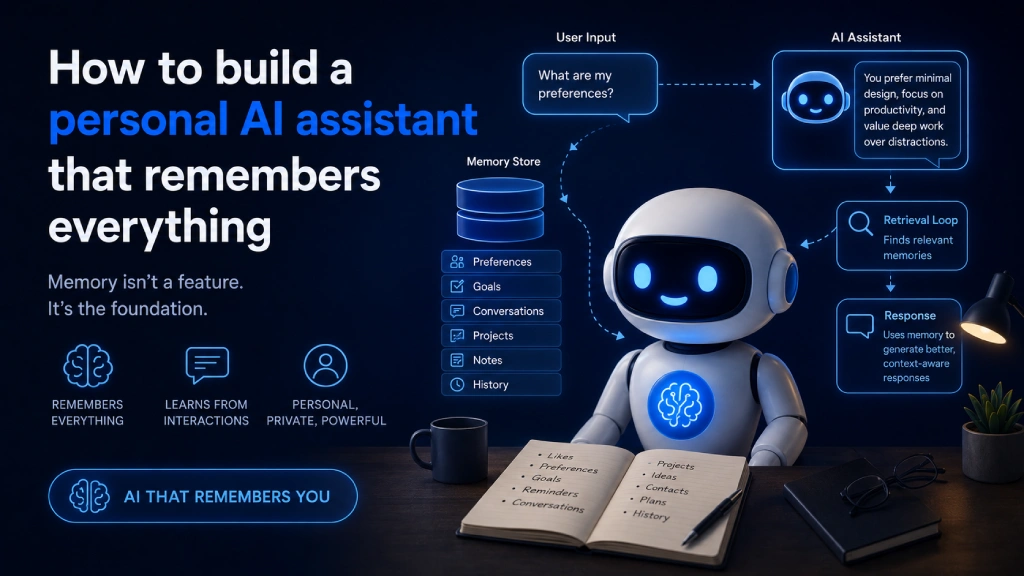
For decades, digital assistants have had a built-in limitation: they forget. Each interaction starts from zero. That is now changing. A new generation of AI systems is being designed around memory—not as a feature, but as a core layer.
Industry research shows that modern AI agents combine a language model with an external memory system that stores, retrieves, and updates knowledge over time, enabling continuity and learning across sessions.
What follows is a concise, field-tested blueprint to build one.
The architecture that makes “memory” possible
At the heart of persistent AI assistants is retrieval-augmented generation (RAG)—a method that connects models to external data sources instead of relying only on training data.
The system has three non-negotiable layers:
- Embedding layer → converts text into vectors
- Memory store → a vector database for semantic recall
- Retrieval loop → fetches relevant memory at runtime
Vector databases enable assistants to retrieve information based on meaning, not exact words—allowing flexible recall across conversations.
The failproof build (minimal, production-ready pattern)
1) Install core stack
pip install openai langchain chromadb tiktoken
2) Ingest and store memory
Convert user data into embeddings and persist it.
from langchain.embeddings import OpenAIEmbeddings
from langchain.vectorstores import Chroma
embedding = OpenAIEmbeddings()
db = Chroma(
collection_name=”memory”,
embedding_function=embedding,
persist_directory=”./memory_db”
)
def store_memory(text):
db.add_texts([text])
What this does:
Every interaction becomes a searchable memory unit—structured, stored, and reusable.
3) Retrieve relevant memory
def recall_memory(query):
results = db.similarity_search(query, k=3)
return “\n”.join([r.page_content for r in results])
This step is critical. Instead of loading everything, the system pulls only the most relevant past information—keeping responses accurate and efficient.
4) Generate responses with memory
from langchain.chat_models import ChatOpenAI
llm = ChatOpenAI(model=”gpt-4o-mini”, temperature=0)
def ask_assistant(query):
memory_context = recall_memory(query)
prompt = f”””
You are a personal AI assistant.
Use past memory if relevant.
Memory:
{memory_context}
User:
{query}
“””
response = llm.predict(prompt)
store_memory(f”User: {query} | Assistant: {response}”)
return response
5) Run it
print(ask_assistant(“What are my preferences?”))
The assistant now:
- Stores every interaction
- Retrieves context intelligently
- Improves responses over time
Why this works
This design mirrors how production AI systems operate today. Instead of expanding the model itself, developers externalize memory—making systems cheaper, faster, and more adaptable.
RAG-based systems are widely adopted because they allow AI to access up-to-date, private, and personalized data without retraining the model.
More importantly, structured memory reduces hallucinations and improves factual grounding by anchoring responses in stored data.
The real challenge: memory management
“Remember everything” is not literal. Effective systems decide:
- What to store (signal vs noise)
- What to forget (decay, pruning)
- What to prioritise (recent vs important)
Advanced systems now layer multiple memory types—short-term context, long-term storage, and structured knowledge graphs—to maintain coherence over time.
The shift underway
AI assistants are moving from reactive tools to persistent systems that accumulate knowledge. Memory is becoming the defining layer—turning interactions into continuity.
The implication is simple: the most useful AI will not be the one that knows the most.
It will be the one that remembers you.