The buzzword has now shifted from chatbots to “agents”—systems that don’t just answer questions, but take actions. From Silicon Valley startups to enterprise software giants, the push is clear: AI should do the work, not just describe it.
The shift is driven by frameworks like LangChain, which streamline how developers connect large language models to tools such as web search, databases, or internal APIs. The result: what once required weeks of engineering can now be prototyped in under an hour.
The core of an agent
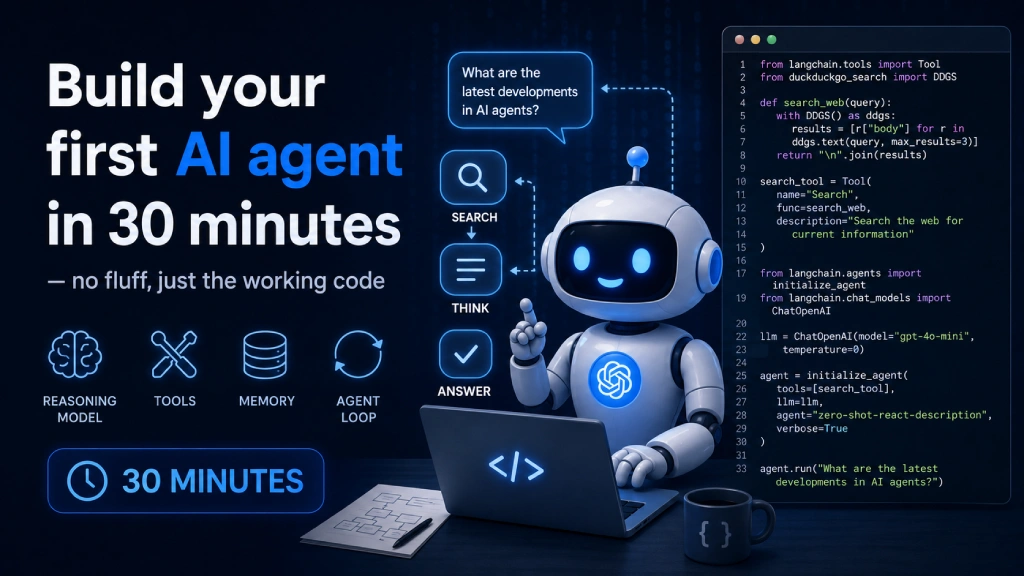
An AI agent combines four elements: a reasoning model, a set of tools, short-term memory, and a loop that decides what to do next. This loop—often based on the ReAct (reasoning + acting) approach—lets the system break down a task, call external functions, and refine its response step by step.
That architecture is what allows an agent to move beyond static answers into dynamic problem-solving.
The 30-minute build
1) Install dependencies
pip install langchain openai duckduckgo-search
2) Set your API key
import os
os.environ[“OPENAI_API_KEY”] = “your-api-key”
3) Add a simple tool (web search)
from langchain.tools import Tool
from duckduckgo_search import DDGS
def search_web(query):
with DDGS() as ddgs:
results = [r[“body”] for r in ddgs.text(query, max_results=3)]
return “\n”.join(results)
search_tool = Tool(
name=”Search”,
func=search_web,
description=”Search the web for current information”
)
4) Initialize the agent
from langchain.agents import initialize_agent
from langchain.chat_models import ChatOpenAI
llm = ChatOpenAI(model=”gpt-4o-mini”, temperature=0)
agent = initialize_agent(
tools=[search_tool],
llm=llm,
agent=”zero-shot-react-description”,
verbose=True
)
5) Run it
agent.run(“What are the latest developments in AI agents?”)
Within minutes, the system can decide when to search, gather external information, and return a structured answer—without hardcoding each step.
Why this matters now
Instead of building single-purpose models, developers are now assembling systems that can reason across tasks and interact with real-world data.
Major players—including OpenAI and Google—are investing heavily in this direction, embedding agent-like capabilities into productivity tools, coding assistants, and enterprise platforms.
For developers, the barrier to entry has dropped sharply. The complexity hasn’t disappeared—but it has been packaged.
What comes next
A basic agent is only a starting point. With modest extensions, the same setup can:
- Store conversation memory
- Query internal documents
- Execute API calls
- Automate routine workflows
Building your first agent no longer requires a research team. Just a clear use case—and about 30 minutes of code.